"The game is pretty near up"
In November 1776 the American army lost Forts Washington and Lee on the Hudson and fell back across New Jersey with the
British close behind. In the first days of December it escaped over the Delaware into Pennsylvania. On December 18
Washington told his brother Samuel that he had fewer than 3,000 men fit for duty, that the enlistments of nearly all
of them would run out within a fortnight, and that without a new army "I think the game is pretty near up". A few
days before the crossing Thomas Paine's The American Crisis was published in Philadelphia, with its opening line,
"These are the times that try men's souls." It is often said to have been read to the troops before they crossed; the Pennsylvania
park notes that no document of the time shows it.
Gathering the boats
The crossing was possible because the boats were already on the Pennsylvania side. On December 1, still retreating,
Washington ordered Colonel Richard Humpton to collect every boat he could at the ferries near Trenton, and to
"particularly attend to the Durham Boats". On December 8 he asked General William Maxwell to see that all the boats on
the river were secured or destroyed, to gather them under guard at Tinicum, on the Bucks County bank opposite
Hunterdon County, and to call on the militia of Pennsylvania or New Jersey for the guards. Ten days later he could
write that every boat for seventy miles above Philadelphia had been brought over or destroyed. It was done to stop the
British following him. It also gave him his fleet.
Who did the work on the upper river is less certain. Mount Vernon credits the New Jersey militia, without names.
Hunterdon County tradition gives the credit to Captain Daniel Bray of Kingwood, a river boatman and militia officer,
and the story is told at the park to this day; the county's own history programme has asked whether it is man or myth,
and none of Washington's surviving orders names him.
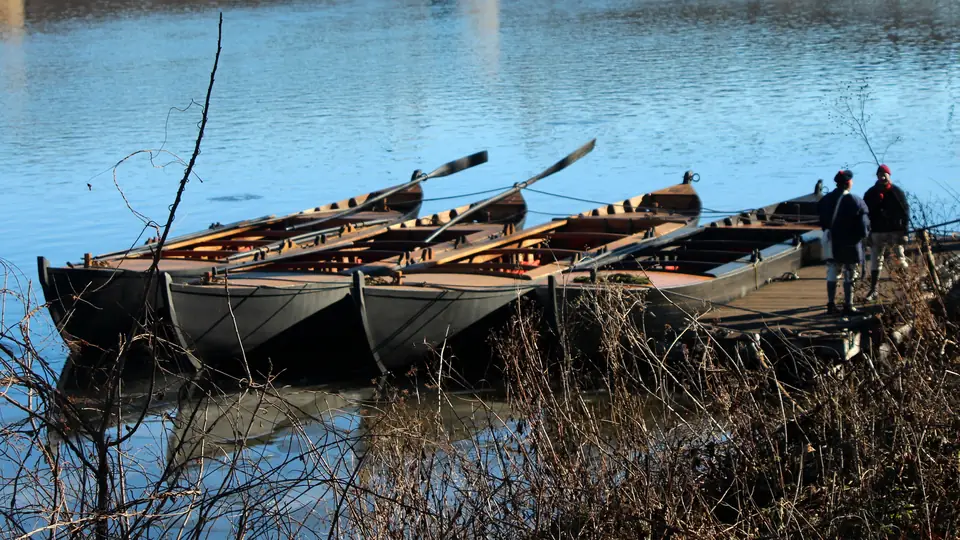
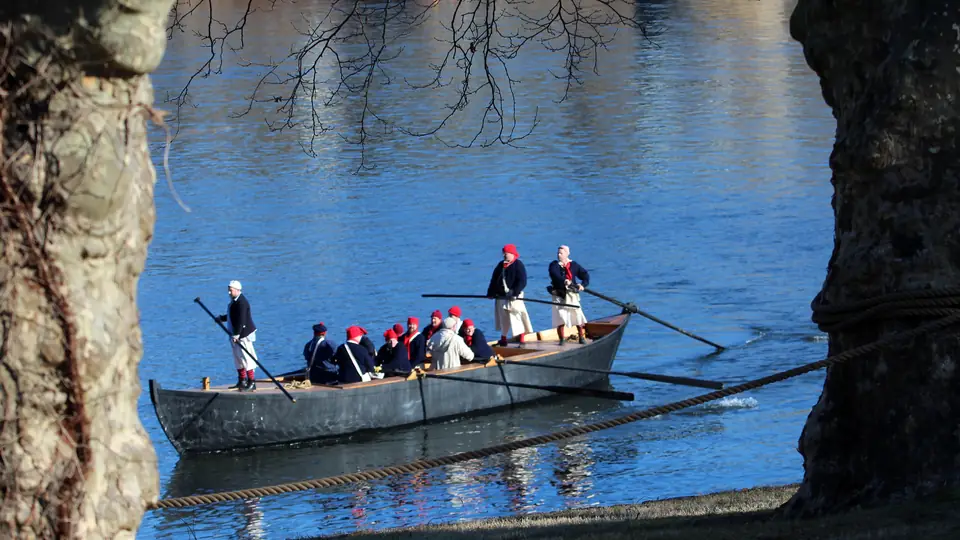
The Durham boats were the freight boats of the Delaware, the kind that carried the iron of the furnaces around Durham,
in upper Bucks County, down to Philadelphia: forty to sixty feet long, pointed at both ends and drawing only twenty
inches fully loaded. About twenty were
needed. Most of the men crossed standing in them, while the horses and the eighteen cannon went over on the flat
ferries. The rowing fell to Colonel John Glover's regiment of seamen from Marblehead, Massachusetts, and to watermen
from around Philadelphia who knew this stretch of the river.
Christmas night
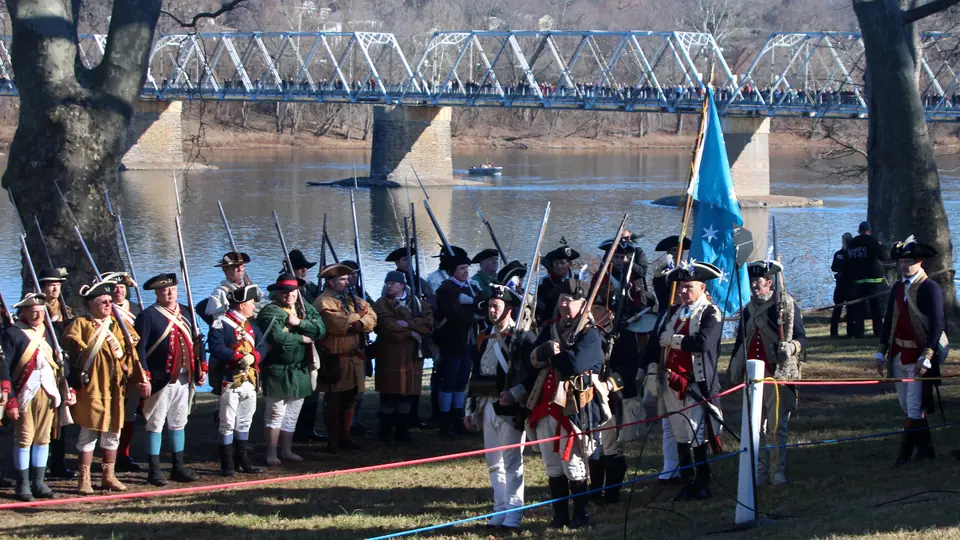
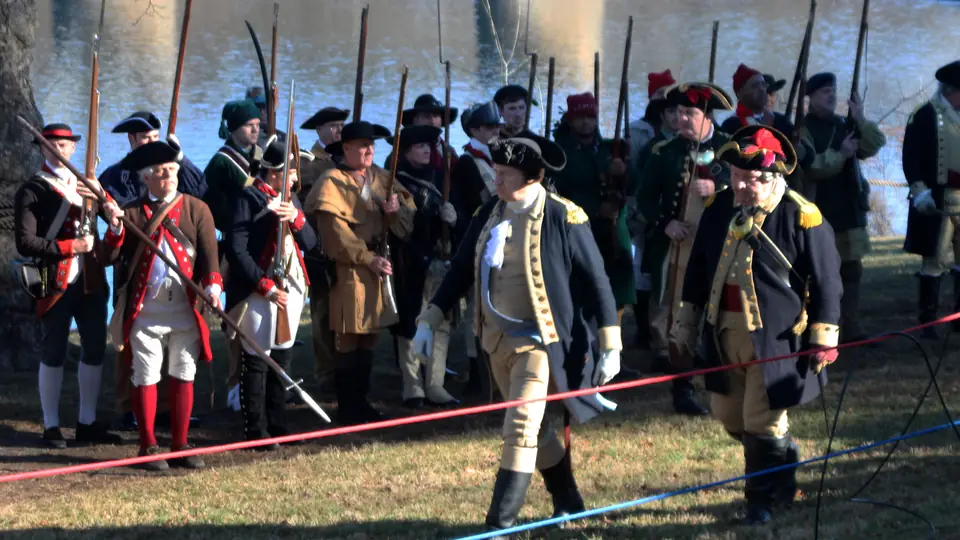
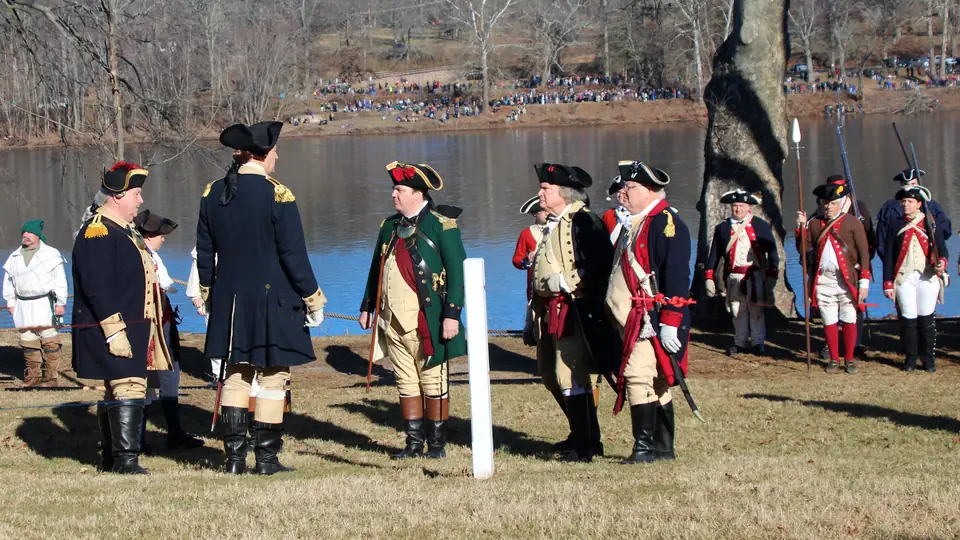
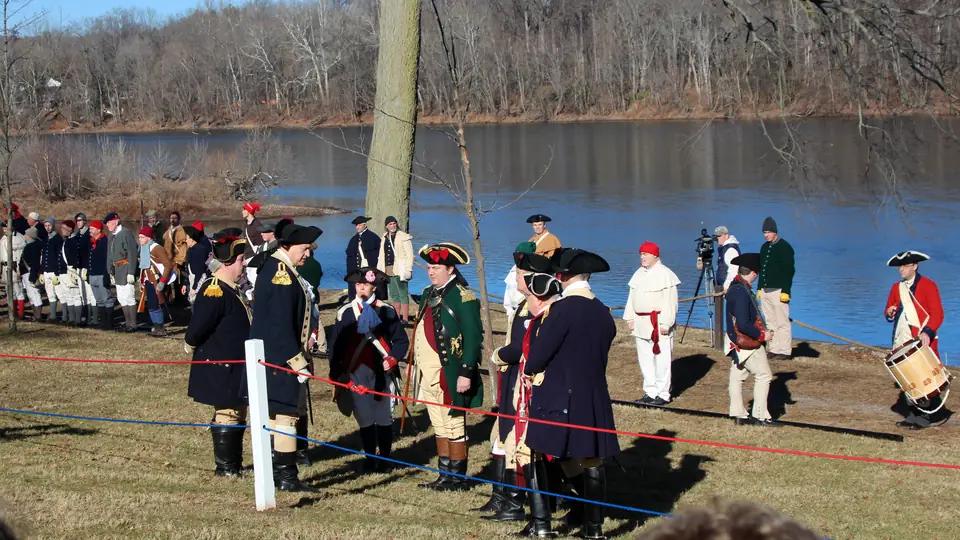
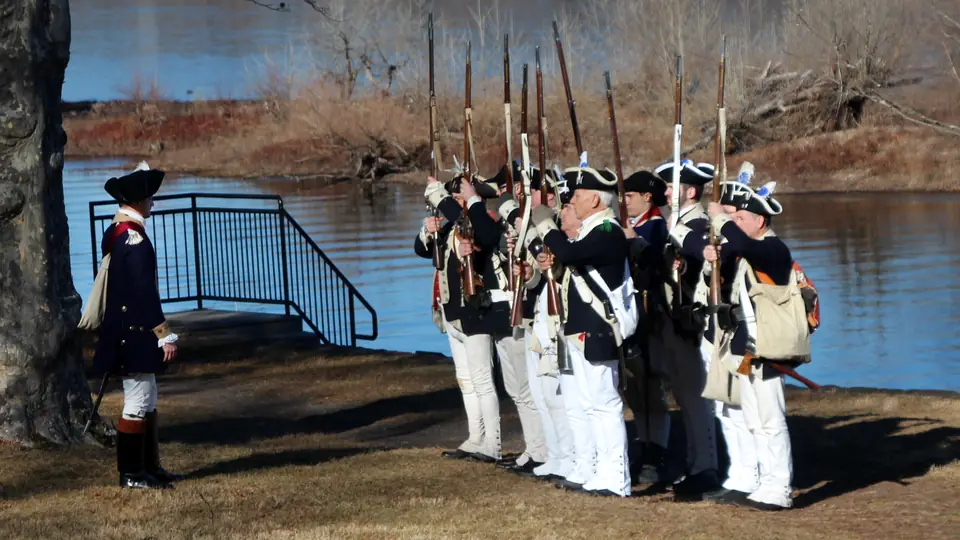
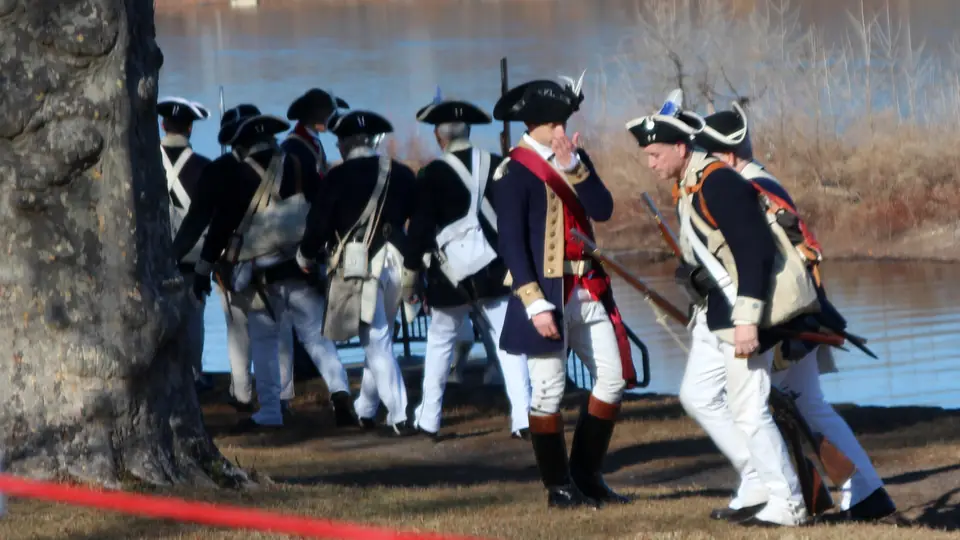
At dusk on December 25 the troops paraded behind McConkey's Ferry and began to cross as soon as it was dark. The plan
was to have everyone over by midnight and to reach Trenton by five in the morning. Floating ice slowed every boat, and
by eleven a storm was blowing sleet, hail and snow. It was three o'clock before the last of the artillery was across
and nearly four before the column moved off. Two other forces that were to cross lower down, one at Trenton and one
near Bristol, were stopped by the ice. Henry Knox, who directed the embarkation, wrote that the ice "made the labour
almost incredible".
Trenton
The army marched in two divisions, one by the river road and one by the upper road through Pennington, and Washington
rode with the upper one. He had given up hope of surprise but pushed on. The upper division reached the first Hessian
post "exactly at eight", he reported, and three minutes later he heard the other division open fire. Colonel Johann
Rall's three Hessian regiments, about 1,400 men, tried to break out towards Princeton, were surrounded, and laid down
their arms within about an hour. Rall was mortally wounded. Washington counted 23 officers and 886 men taken prisoner, and
American losses were a handful: among the wounded was a young lieutenant, James Monroe, later the fifth president. The Hessians were not drunk, whatever the story says. With stronger British forces close by, Washington
took his prisoners back across the river the same evening.
The Ten Crucial Days
He was back in New Jersey within the week. On January 2, 1777, his army held the bridge over the Assunpink Creek in
Trenton against three assaults by Lord Cornwallis. That night it left its campfires burning, slipped away by a side
road, and on the morning of January 3 beat a British force at Princeton, where General Hugh Mercer was mortally
wounded. By January 6 the army was in winter quarters at Morristown, and the British had pulled back towards New
Brunswick, giving up most of New Jersey.
Why it mattered
Nothing was settled at Trenton; the war had years to run. What changed was whether it would go on at all. In the
middle of December Washington thought the game nearly up, and wrote that the people of New Jersey were making their
submissions to the Crown as fast as they could. On December 28 he wrote that he had "a fair Opportunity" of driving the
enemy out of the state. He offered the men whose time was up a bounty to stay six weeks more, the army held together,
and a cause that had looked lost began to look as if it could be won. Mount Vernon calls Trenton "a positive turning
point" for the Americans.
The painting
Emanuel Leutze painted Washington Crossing the Delaware in Düsseldorf in 1851, and it hangs in the Metropolitan
Museum of Art in New York. It is a monument and not a record. The boat is far too small, the flag was not adopted
until six months after the crossing, the river is shown far wider than it is (less than 300 yards here), and Monroe,
who is shown in Washington's boat, crossed with another company. A full-size copy hangs in the Pennsylvania park's visitor
center.
The two parks today
Washington Crossing State Park, on the New Jersey side, is
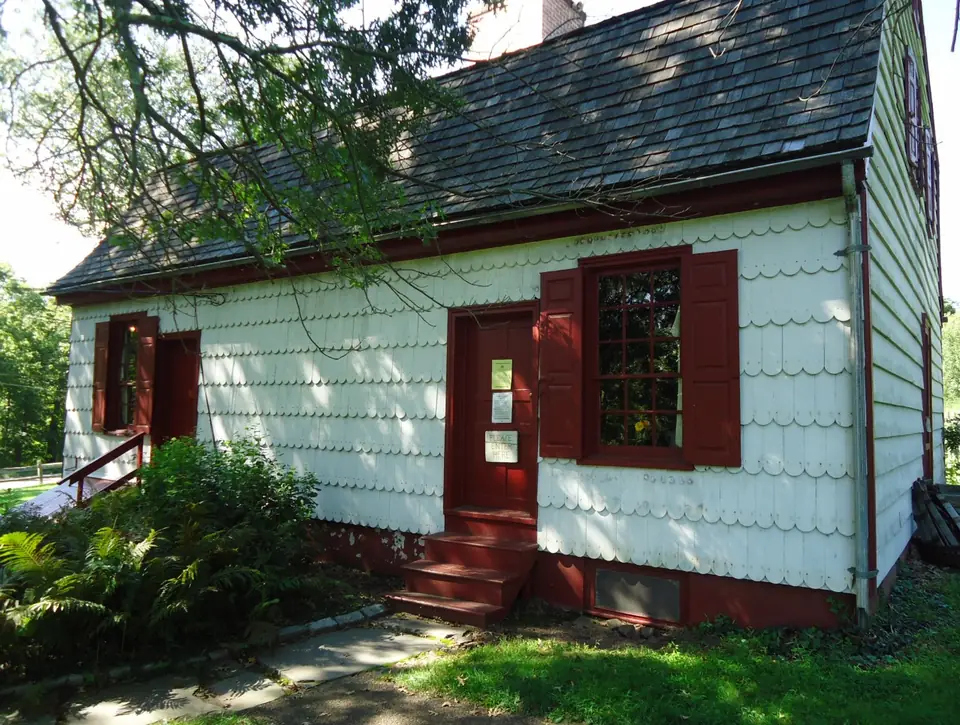
where the army landed. The Johnson Ferry House, the farmhouse and tavern that Garret Johnson built about 1740, still
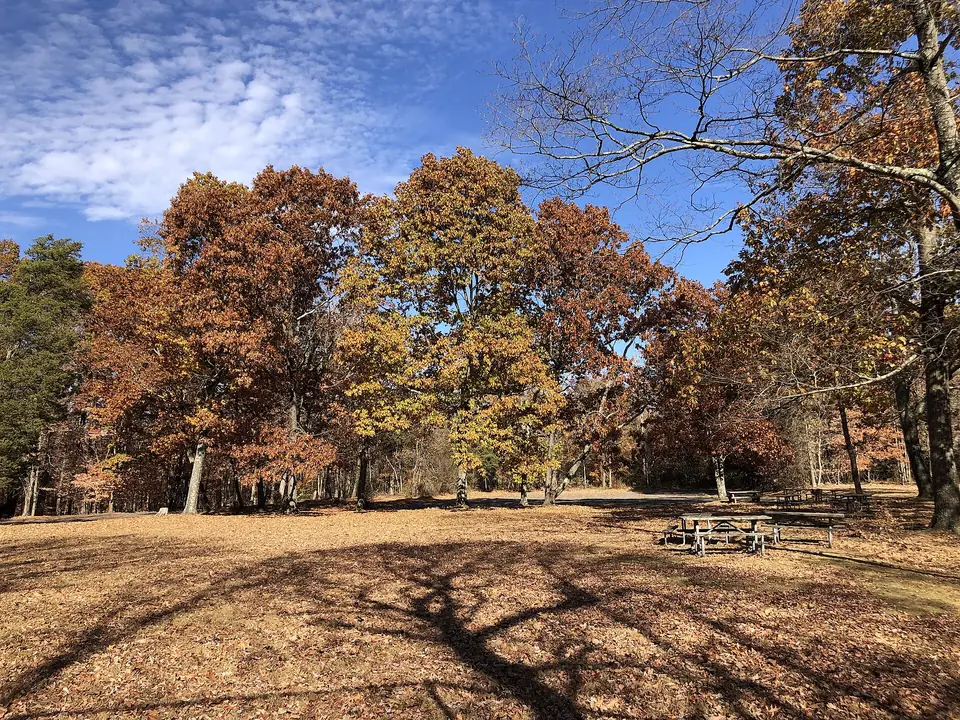
stands above the landing, and Washington and his officers probably used it that night. Around it are 13 miles of
trails, a nature center and a natural area of old woodland. A new museum and visitor center has been built for the
anniversary to show the Swan collection of more than 500 objects from the Revolution; it was due to open in 2026, so
check with the park before you plan a visit around it.
Washington Crossing Historic Park, in Pennsylvania, is where the
boats set out. Its lower section, at the crossing, has McConkey's Ferry Inn, the nineteenth-century village of
Taylorsville, the barn that houses the replica Durham boats used in the reenactment, and a visitor center. The upper
section is three and a half miles north along River Road: Bowman's Hill Tower, the Thompson-Neely House where part of
the army camped, and the graves of soldiers who died during that December's encampment.
The bridge between them, opened in 1905, is the narrowest road bridge the river's bridge commission looks after, and
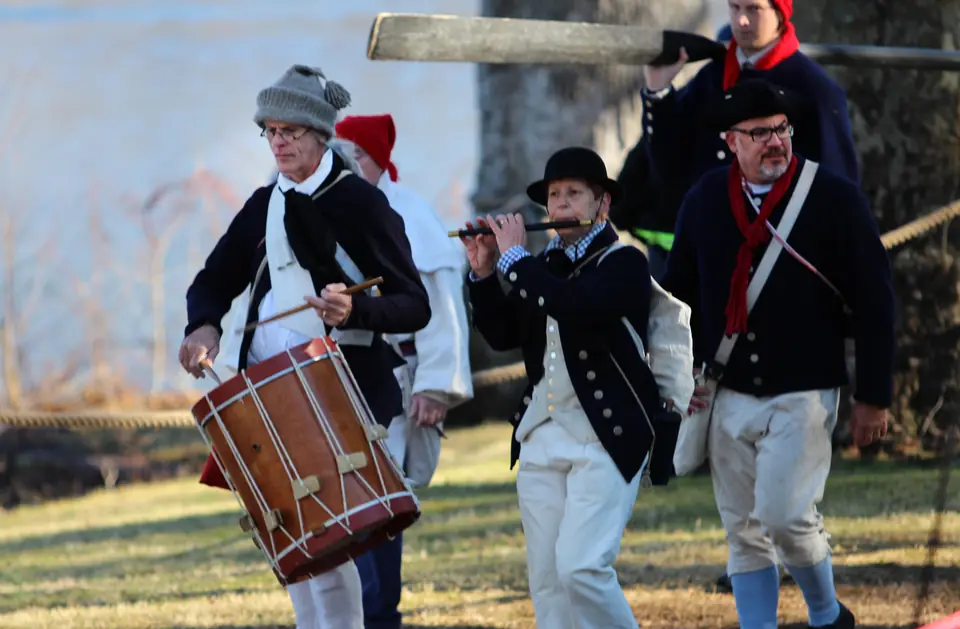
has a plank footway on its downriver side. On Christmas Day 1980 the boats were frozen in, and the reenactors crossed by the
bridge on foot.
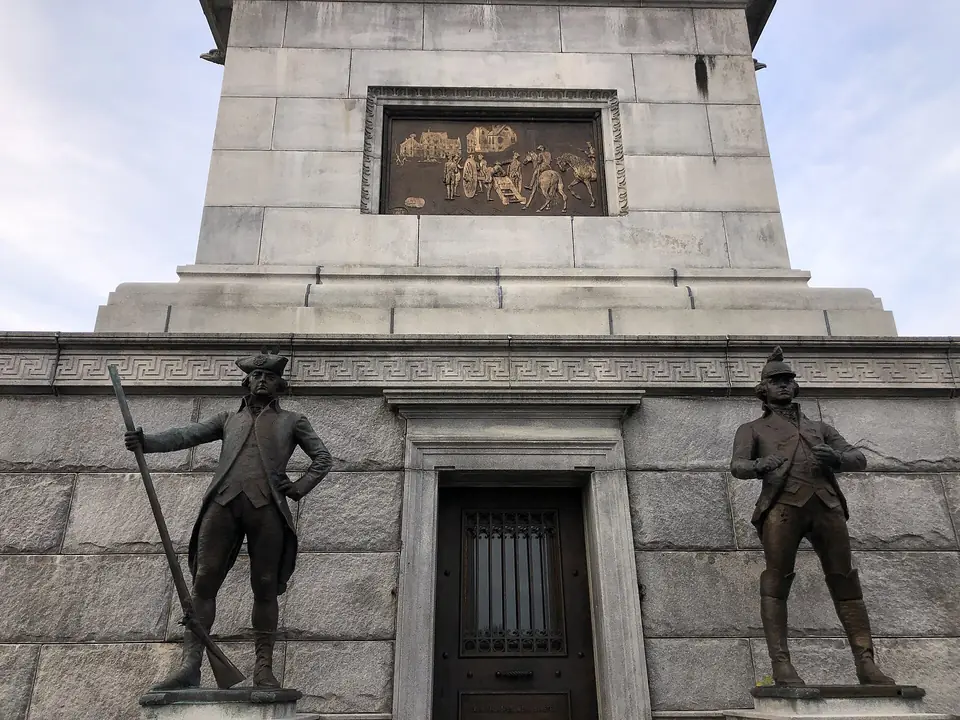
From here the story continues in Trenton, at the Trenton Battle Monument
and the Old Barracks, and at
Princeton Battlefield. The rest of the war in this state is in
Revolutionary New Jersey.